You checked the mattress. Stripped the sheets, went over every seam, found nothing. And the bites keep coming. Here’s the thing nobody tells you at first: bed bugs don’t stay put in beds. Give them enough time and they’ll move into the carpet, into the couch, into whatever’s nearby and dark enough to hide in. If that’s where yours have gone, here’s how you’d actually know, and what to do about it.
The Short Answer
Bed bugs can absolutely live in carpet and furniture, for months, without needing to feed. They’re not diggers, so forget the idea of them burrowing down into carpet padding like fleas — they stick to the surface, along edges, in seams, wherever a baseboard meets the floor. Furniture works the same way. Fabric or leather, doesn’t matter; they want a fold, a seam, a gap around a cushion. If you’re finding them outside the bedroom, that usually means things have spread further than you thought.
Can Bed Bugs Live in Carpet?
Yes, and honestly it makes sense once you think about what they actually need. Not a bed — just two things: something to feed on nearby, and somewhere dark to disappear into between meals. Carpet does both jobs fine, especially the stretch that runs under a bed frame or hugs a wall a few feet from where you sleep.
Why They Cluster Near the Bed
The EPA notes that bed bugs key in on the carbon dioxide and warmth a sleeping person gives off, and while they can technically cover over 100 feet in a night if they’re desperate, most stick within about 8 feet of wherever someone sleeps. That’s the whole reason carpet next to a bed is worth checking — it’s close enough to feed easily, and it’s basically never disturbed beyond a weekly vacuum.
Why They Stay on the Surface, Not Underneath
What they won’t do is tunnel into the padding underneath. That’s more of a flea thing. Bed bugs stay flat against the surface — along the pile, tucked where carpet meets a tack strip, or pressed into the fold where it runs up against a baseboard.
Why This Gets Missed So Often
Which is part of why people miss this for so long. Running a vacuum through the open part of a room doesn’t touch a bug sitting in a baseboard gap, and most of us never think to check that spot until the bites just won’t stop, even though the mattress looks completely clean.
Where in the Carpet They Actually Hide
Skip the middle of the room — that’s the last place you’ll find anything. The edges are where it actually happens.
| Location | Why It’s a Hiding Spot | What to Look For |
|---|---|---|
| Where carpet meets the baseboard | Dark, tight, rarely vacuumed | Shells, dark fecal spots, live bugs along the seam |
| Under the bed frame | Closest carpet to a sleeping host | Rust-colored stains, shed skins |
| Carpet seams and low-traffic corners | Cover that foot traffic never disturbs | Clusters of shells or eggs |
| Under furniture legs or rugs | Permanent shade, barely ever cleaned | Small dark spots, matted or discolored fibers |
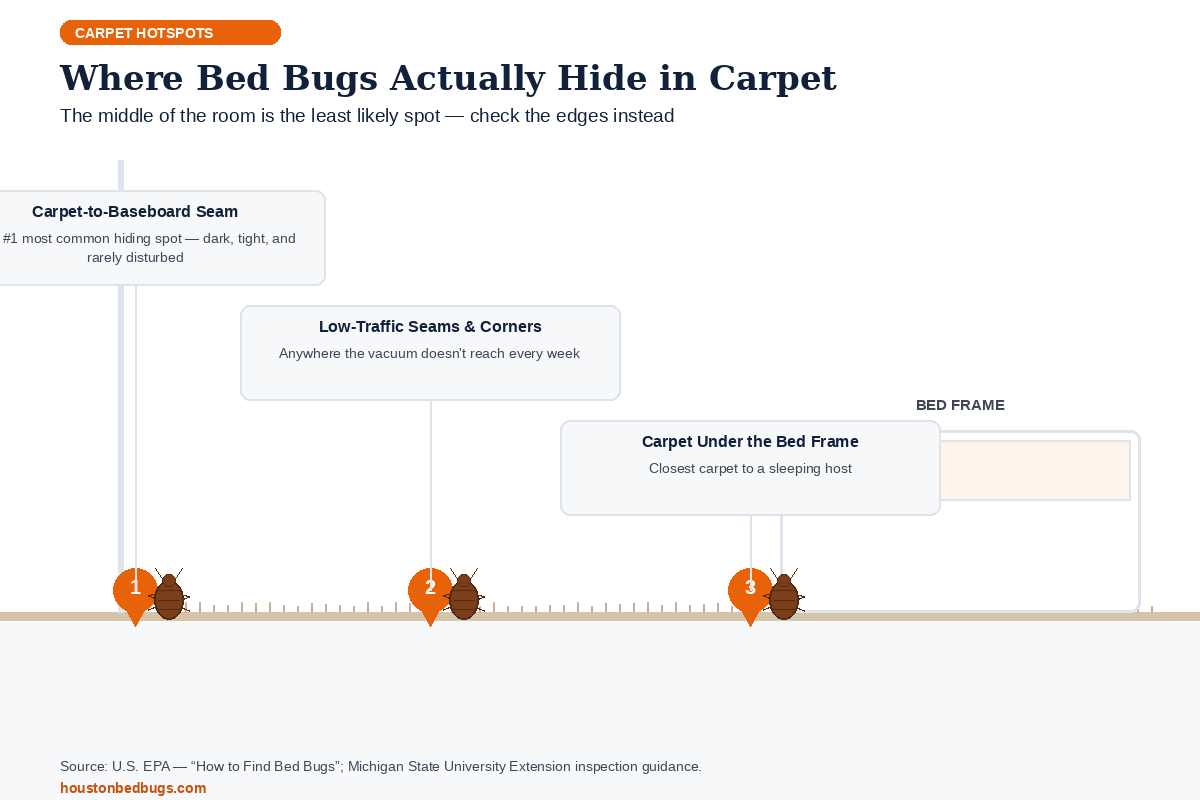 Bed bugs cluster at carpet edges, not in the open middle of a room.
How to Check Your Carpet for Bed Bugs
You need two things for this, according to Michigan State University’s extension entomologists: a decent flashlight and something stiff and thin, like an old gift card. That’s it. Skip the flashlight and you’ll probably miss everything — eggs and freshly hatched nymphs are barely a millimeter and practically transparent.
- Start where the carpet meets the baseboard, right next to the bed.
- Use the card to actually part the fibers. Looking at the surface isn’t enough.
- Hold the flashlight low, at an angle, not straight down — shadows give away shells and fecal spots that a direct beam washes out.
- Don’t stop at the section near the bed. Work the whole perimeter.
- Check under any furniture legs sitting on the carpet. Those spots basically never get touched.
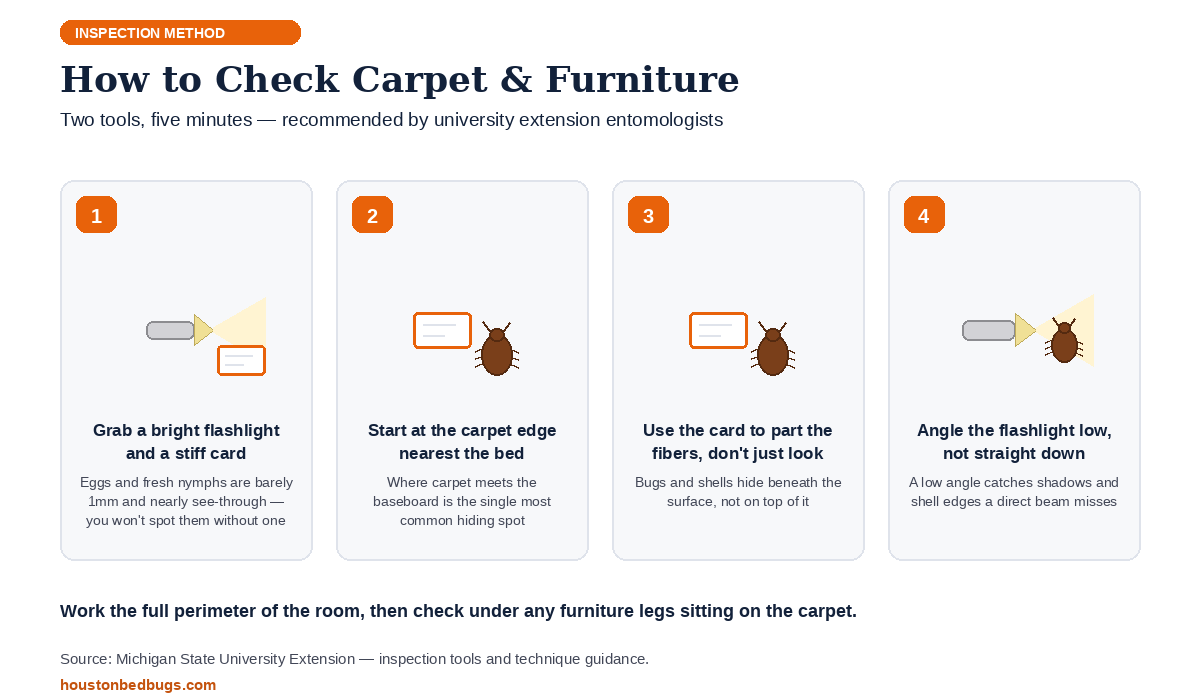 A flashlight and a stiff card are the two tools recommended for a real inspection.
Can Bed Bugs Live in Couches and Other Furniture?
Yes, and the material doesn’t really matter. Fabric, leather, it’s all the same to a bed bug — what they care about is structure, not surface. On a fabric couch, that’s the seams, the piping, wherever a cushion meets the frame. Leather’s no different, just less obvious: they’ll tuck into a fold along the backrest, squeeze around the legs, or hide inside a recliner’s moving parts. Leather can’t stretch the way fabric does, but a bug doesn’t need stretch. It needs a seam.
Where Furniture Type Matters (and Where It Doesn’t)
Couches, recliners, ottomans, even the hinges on a dresser near the bed — all fair game once an infestation’s had time to build. Fabric type isn’t the deciding factor. Dark, tight, close to a meal — that’s what matters to them.
The Secondhand Furniture Risk
Worth mentioning: a used couch or recliner is one of the more common ways bed bugs get into a home in the first place. A piece of furniture can sit infested in someone else’s apartment for weeks, look completely fine, then get hauled into your living room by whoever bought it next. If you’re picking up secondhand furniture, five minutes checking the seams before it comes through the door is worth it.
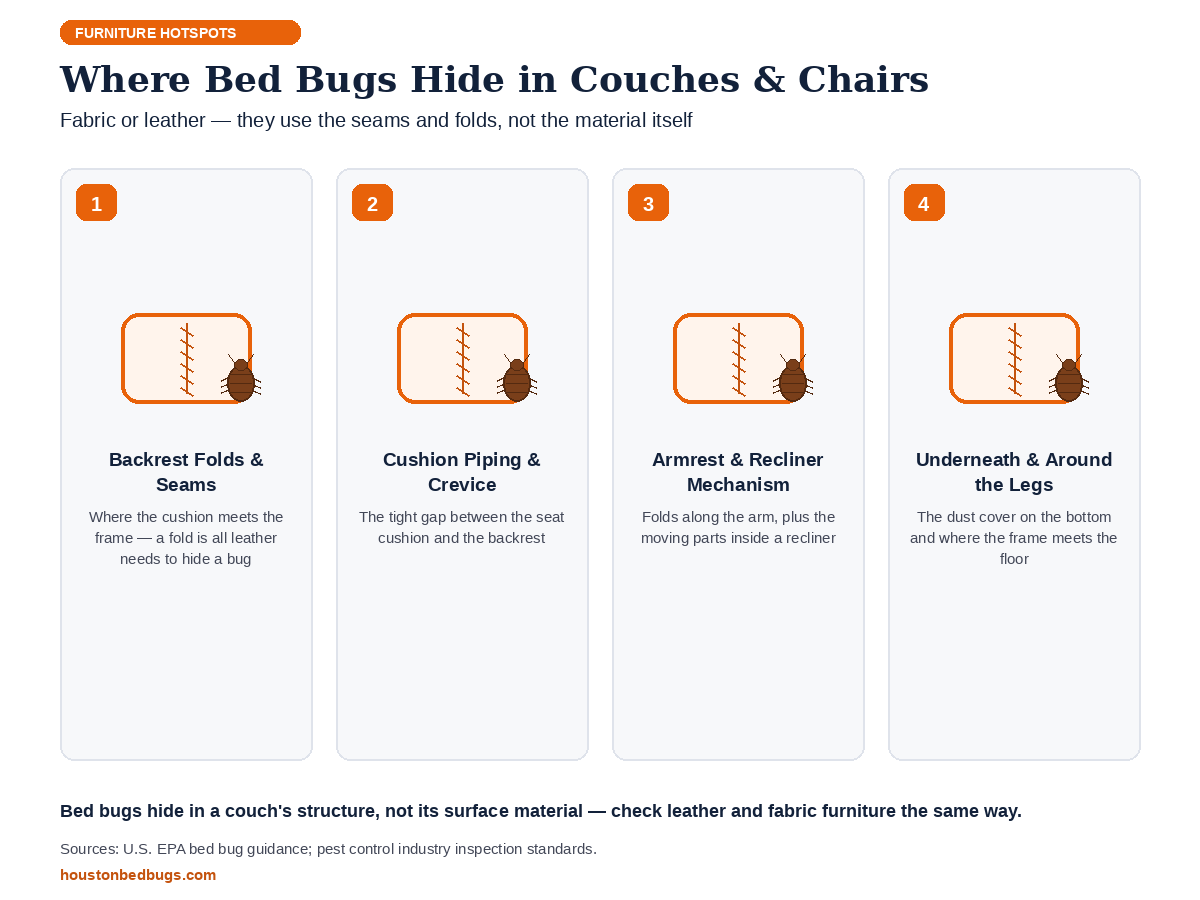 Bed bugs hide in furniture seams and folds, whether fabric or leather.
 A sofa corner seam — exactly the kind of fold bed bugs use to hide.
Where to Check on a Couch or Chair
- Piping and seams on every cushion — front and back
- The crevice where a cushion meets the arm or backrest
- Underneath, including the dust cover on the bottom
- Inside recliner mechanisms and folds in leather backrests
- Around the legs, where the frame touches the floor
Look for what you’d check for on a mattress — rust-colored stains, small dark spots that smear like ink, shed shells left behind as nymphs grow. Not sure what a shell even looks like up close? Our shell identification guide walks through every molt stage with photos and sizes.
Bed Bugs in Carpet vs. Carpet Beetles
Carpet’s also prime real estate for carpet beetles, and people mix the two up all the time — fair enough, both show up as tiny brownish specks buried in fibers. But the difference actually matters here: carpet beetles chew fabric, they don’t bite people, and they don’t call for the same treatment at all.
| Feature | Bed Bug | Carpet Beetle |
|---|---|---|
| Body shape | Flat, oval, no bristles | Oval but fuzzy or bristly, especially as larvae |
| Antennae | Long and thin, no club | Short with a clubbed tip |
| What it does to you | Bites to feed on blood | Doesn’t bite — feeds on wool, fur, and other natural fibers |
| Where it clusters | Within about 8 feet of where you sleep | Anywhere with natural-fiber material: closets, wool rugs, stored clothing |
Bristly instead of smooth, tucked in a closet instead of near the bed? You’re almost certainly looking at a carpet beetle.
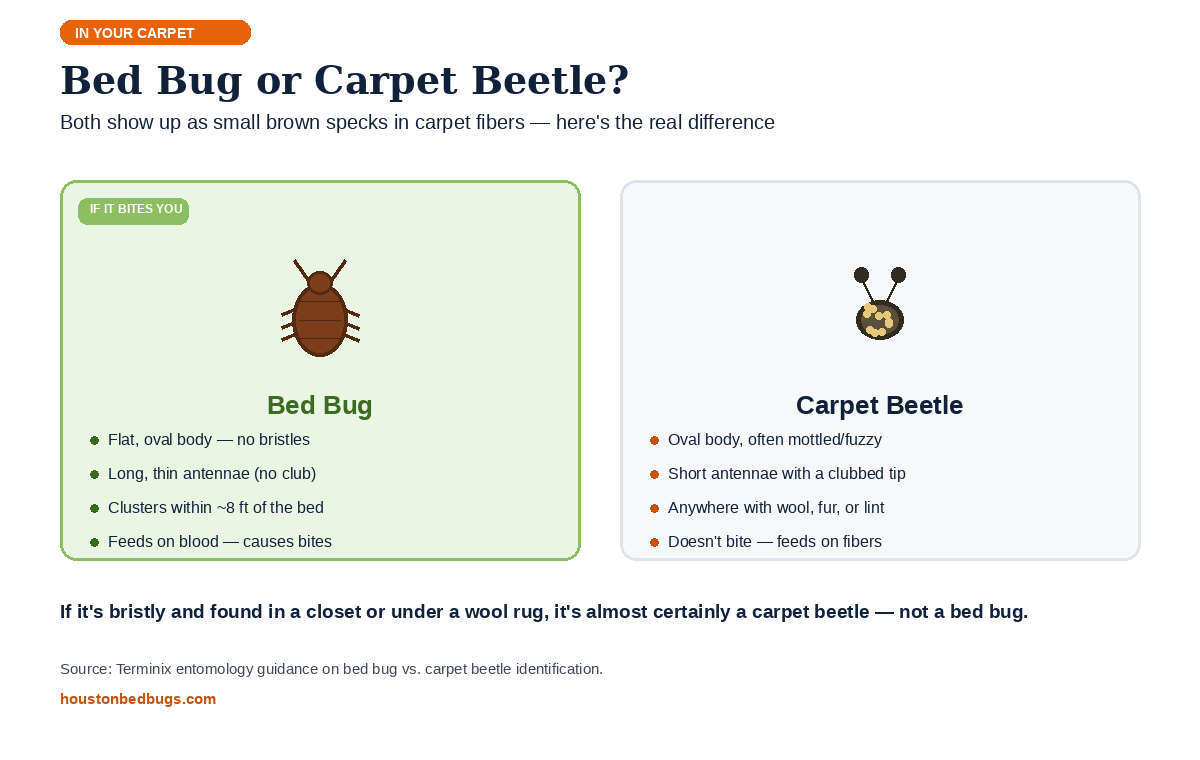 Bed bugs bite and cluster near the bed; carpet beetles don’t bite and prefer natural fibers.
What Finding Them in Carpet or Furniture Means
Finding a few in the carpet right next to the bed, or in a couch in the same room? Not great, but not alarming either — that’s still inside their normal range. What actually raises a flag is finding them in a couch down the hall, or carpet nowhere near a bedroom. That kind of spread usually means the population outgrew its original hiding spots and had to push outward.
Either way, carpet and furniture are just harder to treat than a mattress. More surface, more depth, more places for a bug to sit out of reach. Contact sprays miss whatever’s tucked into a carpet seam or buried in a recliner mechanism, and foggers do even less once things have spread this far — they release from one spot in the room and never actually reach into fibers or furniture seams.
Carpet in Apartments and Shared Buildings
Here’s a wrinkle a single-family home doesn’t have: wall-to-wall carpet that runs from one unit straight into a shared hallway gives bed bugs a literal road to travel. A population that starts in one bedroom can work its way along a hallway seam toward the neighbor’s door without a person ever carrying it there.
If you’re renting and you find evidence near a shared wall or hallway, flag it to building management, not just your own unit. Our guide on how bed bugs spread between apartments covers what’s worth documenting and who to tell first.
What to Do If You Find Bed Bugs in Carpet or Furniture
Once they’ve spread past the bed, treating one spot won’t fix it. Start with a full inspection using our Houston inspection guide — check everything, not just wherever you first found evidence. Carpet and upholstery hide bugs at depths a mattress just doesn’t have, which is why whole-room heat treatment tends to work better here — it gets into fibers and seams a spray can’t reach, and you don’t have to gut a couch or tear up flooring to get there.
If cost is the thing holding you back, our extermination cost guide lays out what treatment typically runs around Houston, so you’re not calling in blind.
Serving Houston, Katy, Cypress & Sugar Land.
Frequently Asked Questions
How long can bed bugs survive in carpet without feeding?
Several months, depending on the temperature and humidity. They don’t need to eat constantly, which is exactly why carpet and furniture work as long-term hideouts even in a room that doesn’t get used every night.
Can bed bugs live in a rug on top of hardwood floors?
Yes — a rug gives them the same dark, undisturbed cover that wall-to-wall carpet does. Check underneath it and the floor beneath, not just the top.
Will steam cleaning the carpet get rid of bed bugs?
It kills on contact, but only wherever the steam actually reaches. Anything tucked deep in a seam or under a baseboard lip can survive one pass — our full breakdown of steam treatment gets into exactly where it works and where it doesn’t, which is why it’s best treated as one part of a plan, not the whole fix.
Can bed bugs live in a leather couch if there’s no fabric to hide in?
Yes. Leather doesn’t need fabric for them to hide in — the folds, seams, and creases built into the piece itself work just fine, along with gaps around the legs and inside recliner mechanisms.
Should I throw away a couch or carpet with bed bugs?
Not necessarily. Both can usually be treated instead of replaced, especially with professional heat treatment. Tossing furniture without treating the rest of the room often just moves the problem somewhere else, since bugs found on one piece have almost always already spread nearby.
Written by James Carter — James covers bed bug identification, treatment, and prevention for Houston Bed Bugs, a Texas-licensed bed bug extermination company serving Houston, Katy, Cypress, and Sugar Land. Not sure what you’re dealing with? Call (833) 809-0699, or see our full bed bug pest control in Houston overview. For neighborhood-level infestation data, see our Houston Bed Bug Report.